

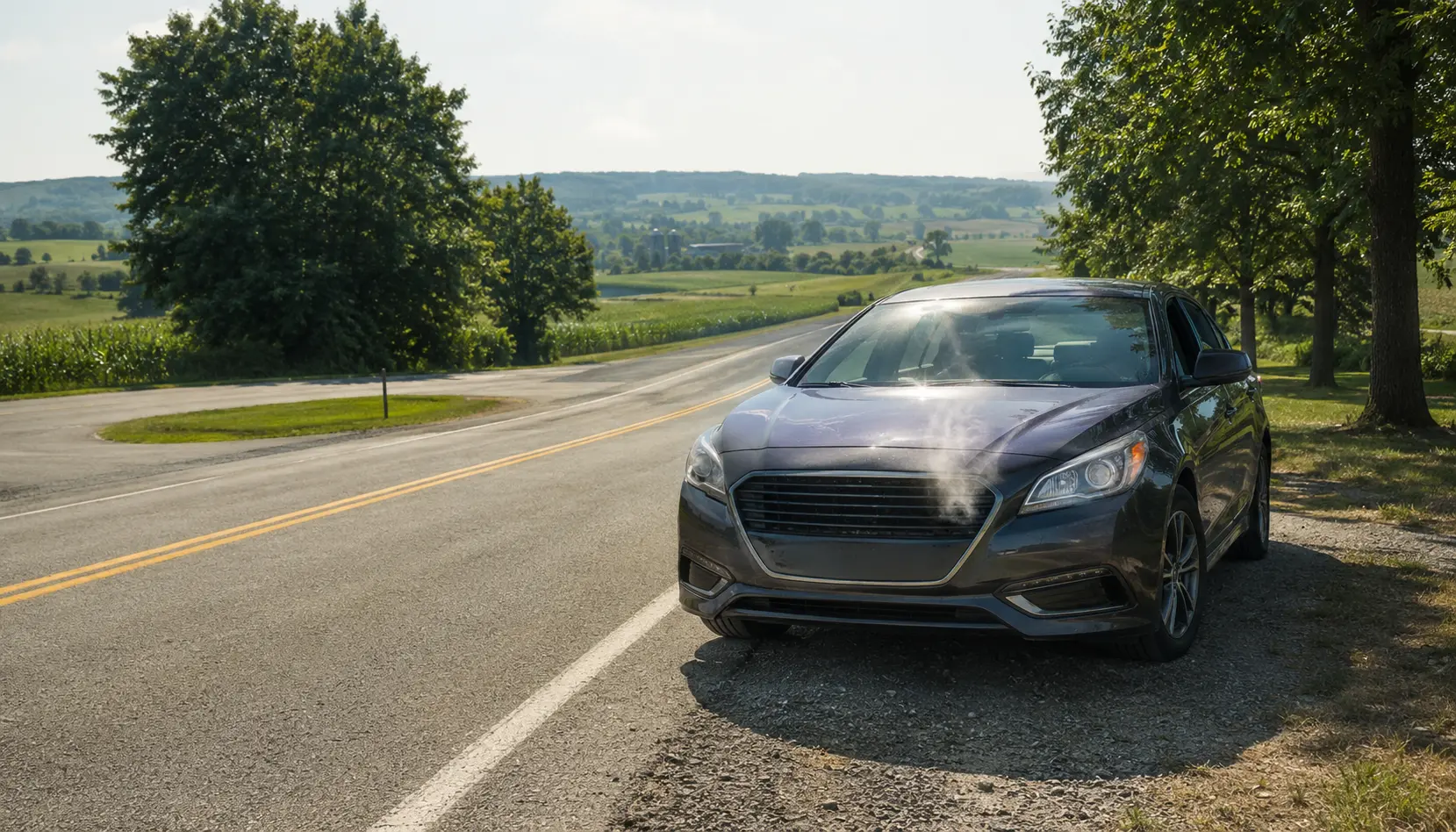
Imagine you’re heading home to Oley after a long day in Reading. It’s one of those hot July afternoons where temperatures have climbed well into the 90s. Traffic slows near Route 73, your air conditioner is working overtime, and then you notice something unusual: the temperature gauge is slowly creeping higher than it normally does.
At first, it doesn’t seem like a big deal.
A few more minutes pass, and you catch a faint sweet smell coming through the vents. Then a small wisp of steam appears from under the hood.
Suddenly, what started as an ordinary commute has become an unexpected roadside emergency.
Situations like this happen every summer throughout Berks County, and they rarely occur without warning. In many cases, the cooling system has been giving subtle clues for days or even weeks before the engine finally overheats.
At Limitless Auto Center LLC in Oley, PA, ASE Certified Technicians diagnose cooling system problems using professional testing procedures instead of guesswork. As a NAPA AutoCare Center, the shop focuses on finding the actual cause of an overheating problem before recommending repairs. When appropriate, Digital Vehicle Inspections (DVI) provide photos, technician notes, and clear explanations so you understand exactly what the technician is seeing.
Whether the issue is a leaking radiator hose, a failing thermostat, a weak pressure cap, or something more complex, identifying the problem early can often prevent significantly more expensive engine repairs later.
Before assuming the radiator or thermostat has failed, it helps to understand what the cooling system is doing, which symptoms matter most, and how a technician separates a minor leak from a potentially serious engine problem.
Engine overheating usually starts long before steam comes from the hood
One of the biggest misconceptions about overheating is that it always happens suddenly. While a catastrophic failure can occur without much warning, most overheating concerns begin with small symptoms that gradually become more noticeable. Drivers often dismiss these clues because the vehicle continues running normally until one exceptionally hot day pushes the cooling system beyond its limits.
Many modern passenger-vehicle engines operate around 195°F to 220°F, although the exact temperature varies with the manufacturer, engine design, load, ambient temperature, and operating strategy. Maintaining that temperature requires several components to work together:
- The radiator removes heat from the coolant.
- The water pump circulates coolant through the engine.
- The thermostat regulates coolant flow as engine temperature changes.
- Cooling fans pull air through the radiator when road speed is not enough.
- The heater core provides cabin heat while acting as a small heat exchanger.
- The expansion or recovery tank allows coolant to expand and contract.
- The pressure cap helps maintain the pressure specified for the vehicle.
- The Engine Coolant Temperature sensor supplies data to the Powertrain Control Module, which may control fan operation and other strategies.
If one part of the system stops performing correctly, engine temperature may begin to climb.
Cooling systems rely on pressure, not just coolant
Many passenger vehicles use cooling-system caps rated at approximately 13 to 18 PSI, but the correct rating is vehicle-specific. Pressurizing the system raises the boiling point of the correct coolant mixture. A typical 50/50 mixture may boil near 223°F to 226°F without added pressure and may resist boiling until roughly 260°F to 265°F under proper pressure. Coolant chemistry, altitude, cap rating, and system design affect these figures.
When coolant boils, steam pockets can form. Steam transfers heat less effectively than liquid coolant, allowing localized hot spots to develop even when the reservoir appears to contain coolant. A weak cap can therefore create serious symptoms without a large external leak.
Professional testing helps determine whether overheating involves coolant quantity, pressure loss, circulation, airflow, heat transfer, sensor inputs, electronic controls, combustion gases, or engine lubrication.
Early warning signs many drivers overlook
- The temperature gauge runs slightly higher than normal.
- The heater blows cooler air at idle.
- A sweet smell appears after driving or parking.
- The coolant level drops over several weeks.
- Cooling fans run more frequently or continuously.
- Small coolant spots appear beneath the vehicle.
- The air conditioner becomes less effective while stopped.
Each symptom can have more than one cause, but a change in normal behavior deserves attention before summer heat adds more stress.
One detail drivers often do not realize is that the temperature gauge depends on accurate sensor information. If coolant becomes extremely low, the sensor may no longer remain fully surrounded by liquid coolant. The gauge can behave erratically or even drop while parts of the engine remain dangerously hot. A sudden loss of cabin heat combined with unusual gauge movement should be treated as a serious warning.
Summer driving around Oley is especially demanding
Trips between Oley, Reading, Fleetwood, and nearby communities can combine rural roads, traffic lights, congestion, and extended idling with the air conditioner operating. At highway speed, air naturally passes through the condenser and radiator. In slow traffic, electric fans must create that airflow. A weak fan motor, failed relay, control problem, or restricted heat exchanger may remain hidden until a hot day near Route 73.
The most common causes of engine overheating in Oley, PA vehicles
Overheating is a symptom, not a diagnosis. It does not automatically mean the vehicle needs a radiator, water pump, thermostat, head gasket, or engine. The correct repair depends on finding why temperature is increasing.
Low coolant level
Coolant does not normally disappear. If the level is low, technicians look for radiator or hose leaks, loose clamps, water-pump seepage, heater-hose deterioration, reservoir cracks, and thermostat-housing leaks. Some leaks appear only under operating pressure. Others evaporate on hot components before they leave a puddle.
A normal-looking reservoir does not always prove the entire cooling system is full. A cap or recovery-hose problem can prevent coolant from returning to the radiator as the engine cools. The system should only be opened and checked according to safe, vehicle-specific procedures after it has cooled completely.
A small leak can progress in a predictable way:
- Coolant level drops.
- Air enters the system.
- Circulation becomes inconsistent.
- Localized hot spots and steam pockets develop.
- Heat transfer decreases.
- Cylinder-head and head-gasket stress increases.
Thermostat problems
The thermostat regulates coolant flow. A thermostat that sticks closed, opens late, does not open fully, has the wrong temperature rating, or was installed incorrectly can restrict circulation. A thermostat stuck open more commonly causes slow warm-up, weak winter heat, or reduced efficiency. Some vehicles use electronically controlled thermostats that add wiring and control considerations.
Technicians may evaluate thermostat operation through scan-tool temperature rise, hose-temperature behavior, measured temperatures, flow behavior, and manufacturer procedures. Overheating alone does not prove that the thermostat is faulty.
Water-pump concerns
Water pumps may be driven by a serpentine belt, timing belt, timing chain or internal drive, or an electric motor. Failure modes include seal leakage, bearing wear, impeller damage, reduced circulation, electrical failure, and control or communication faults. A failing pump does not always create a puddle or obvious noise, and some leaks appear only while the engine is running.
Radiator problems
Bugs, leaves, dirt, and road debris can restrict airflow through the condenser and radiator fins. Inside the radiator, corrosion, deposits, or contamination may reduce coolant flow and heat transfer even when there is no visible leak. Temperature comparisons across the radiator can help identify abnormal cold or hot areas, but measurements must be interpreted with coolant flow, thermostat position, fan operation, and vehicle design.
Cooling-fan failures
A car that overheats in traffic but cools at highway speed often has an airflow concern. Modern systems may use single-speed fans, multi-speed circuits, relays, fan-control modules, or pulse-width-modulated motors. Fan strategy may depend on coolant temperature, air-conditioning pressure, vehicle speed, ambient temperature, engine load, and PCM commands.
A fan failure may progress this way:
- Fan airflow drops while the vehicle is stopped.
- Temperature rises during idling or slow traffic.
- Road-speed airflow temporarily lowers the temperature.
- The driver assumes the problem has disappeared.
- Overheating returns at the next low-speed condition.
Technicians verify commanded operation, electrical supply, grounds, connectors, fan speed, and actual airflow before recommending parts.
Pressure-cap failure
A cap that releases below specification may lower boiling protection. A cap that does not control recovery correctly may also contribute to coolant loss or air entry. The cap is tested against the correct vehicle specification rather than judged by appearance.
Vehicle-specific patterns still require testing
Depending on engine and configuration, technicians may encounter water-pump or coolant seepage on some 2015 to 2020 Ford F-150 models, cooling-fan or relay concerns on some 2012 to 2018 Honda CR-V models, thermostat-operation concerns on some 2010 to 2019 Toyota Camry models, or trapped air after improper service on some 2013 to 2020 Subaru Outback models. These are diagnostic possibilities, not conclusions that apply to every vehicle in those ranges.
What happens inside your engine when it overheats?
Modern engines are built with tight clearances and rely on coolant and engine oil to control heat. As temperature rises, metal parts expand. Aluminum cylinder heads generally expand differently from cast-iron blocks, placing extra stress on sealing surfaces and head gaskets when temperatures exceed the intended range.
Engine oil also carries heat and protects bearings, camshafts, pistons, and other moving parts. Excessive heat can thin and degrade the oil, reduce protection, increase friction, and create still more heat.
Severe or repeated overheating may contribute to:
- Warped cylinder heads
- Head-gasket failure
- Cracked plastic cooling components
- Reduced oil protection
- Bearing or other internal engine damage
Overheating does not automatically mean the head gasket has failed. A loose clamp, weak cap, damaged connector, failed relay, air pocket, minor external leak, incorrect coolant concentration, or biased sensor may create similar symptoms. Testing determines whether the event was caught early or caused additional damage.
After a significant overheating event, repairing the original leak may not be the end of the evaluation. Depending on the severity and duration, technicians may also check engine-oil condition, cooling-system pressure behavior, misfire data, exhaust symptoms, and signs of combustion gases before concluding that no secondary damage occurred.
ASE Technician Tip: The gauge is an important warning device, but it does not identify the failed component. Two vehicles with similar gauge readings may have very different problems.
Should you keep driving if your engine is overheating?
Even if the gauge rises briefly and returns to normal, do not assume the problem has corrected itself. Some instrument displays remain near the normal position across a broad temperature range, so noticeable movement may deserve attention. If the gauge moves again, the heater turns cold, a warning appears, or you smell coolant, stop driving as soon as it is safe.
Stop as soon as it is safe if you notice:
- Steam under the hood
- A red temperature warning
- A gauge entering the hot zone and continuing to rise
- A strong sweet coolant odor
- Loss of engine power
- Knocking or abnormal noises
- The heater suddenly blowing cold while the engine is hot
Take these steps:
- Turn off the air conditioner to reduce load.
- Use the heater on high only as a temporary heat-management measure while finding a safe place to stop.
- Pull over safely.
- Shut the engine off if temperature remains high or a red warning appears.
- Arrange towing when there is severe overheating, steam, power loss, or abnormal noise.
Turning on the heater is not a repair and is not a reason to continue driving. Never remove a radiator or pressure cap while the system is hot or pressurized. Never pour cold water into a severely overheated engine, and keep hands and clothing away from electric fans, which may start unexpectedly.
How ASE Certified cooling-system diagnostics find the real problem
If a vehicle arrives while actively overheating, the first diagnostic step may simply be allowing it to cool. Opening or pressure-testing a hot system would be unsafe and could distort the results. Depending on how hot the vehicle became, an accurate inspection may require additional time before testing can begin.
At Limitless Auto Center LLC, diagnosis begins with the conditions under which the problem occurs. A technician may ask whether the vehicle overheats in traffic, at highway speed, with the air conditioner on, while towing, or after recent cooling-system service. Coolant loss, warning lights, odors, noises, heater behavior, and previous repairs all help direct testing.
Once the engine is safely cool, a technician may inspect coolant level and condition, hoses, clamps, reservoir, radiator, water pump, thermostat housing, belts where applicable, electrical connectors, fan wiring, and dried coolant residue. Not every vehicle requires every test, but a structured order reduces assumptions and unnecessary parts replacement.
Pressure testing can reveal hidden leaks
A professional pressure tester can pressurize a cool system to an appropriate test level. Technicians watch for pressure decay and inspect for hose seepage, radiator leaks, water-pump leakage, thermostat-housing leaks, reservoir cracks, heater-core symptoms, and cap-related pressure loss. A heater-core leak may cause a sweet odor, film on the glass, or damp carpeting. Coolant that reaches a hot surface may evaporate without leaving a puddle.
Pressure loss does not automatically identify an internal engine problem, and normal expansion must not be confused with combustion pressure. Excessive or unusually rapid pressure buildup may require additional testing.
Scan tools and live data help eliminate guesswork
A professional scan tool may be used to review Engine Coolant Temperature, Intake Air Temperature, fan commands, trouble codes, freeze-frame data, air-conditioning pressure inputs, and PCM fan strategy. After a long enough cold soak, ECT and IAT readings should generally be reasonably close to ambient temperature. A significant mismatch can suggest a sensor, wiring, connector, circuit, or module concern.
Scan data is compared with physical evidence such as contact or infrared temperature measurements, thermostat behavior, radiator temperature distribution, coolant circulation, and actual fan operation. An infrared thermometer alone does not prove that a temperature sensor is accurate.
Combustion-gas testing is used when internal leakage is suspected
Repeated coolant loss without an external leak, continuous reservoir bubbles, rapid cold-start pressure buildup, overnight-soak misfires, coolant contamination, or persistent abnormal white exhaust vapor after warm-up can justify further testing. Technicians may use chemical block-test fluid, gas-analysis equipment when available, pressure behavior, scan data, and engine-performance findings.
No single symptom confirms head-gasket failure. Multiple findings should support a recommendation for major engine work.
The repair must be verified
Replacing a part is not the final step. Depending on the repair, verification may include the correct coolant refill, manufacturer-specified bleeding or vacuum filling, a pressure retest, leak inspection, fan verification, live-temperature monitoring, heater-output confirmation, radiator-temperature comparison, an appropriate road test, and a final coolant-level and warning-light check after cool-down.
Correct part selection also matters. Thermostats, pumps, caps, hoses, sensors, and fan assemblies can differ in fit, calibration, materials, sealing, and durability. OEM or professional-grade components may provide more consistent results in some applications, but the right choice depends on the vehicle, component, availability, warranty, and technician experience.
Why summer road trips around Oley, PA expose cooling-system problems
A weakness that remains hidden during short trips may become obvious with higher ambient temperature, long grades, heavy cargo, towing, continuous air-conditioning use, slow vacation traffic, or debris that reduces airflow through the condenser and radiator.
Before a long trip, consider an inspection if you have noticed:
- Coolant loss
- Sweet odors after driving
- A gauge running higher than usual
- Changing heater performance
- Cooling fans running unusually often
- An illuminated Check Engine Light
A pre-trip visit is also a practical time to address an oil change, brake concerns, Pennsylvania State Inspection, or Check Engine Light diagnosis if those services are due.
Three overheating patterns technicians commonly encounter
These examples are not specific customer records, but they show why the conditions surrounding an overheating problem often matter as much as the gauge reading itself.
Steam under the hood was not engine failure
Steam under the hood can make a driver assume the engine has failed. In this pattern, dried coolant near the thermostat housing provides the first useful clue. A pressure test confirms that the housing leaks only when the system is pressurized. Once the housing is replaced, the important work is not finished until the system is properly filled, bled, and checked through a complete warm-up and cool-down cycle.
The pressure cap was the actual cause
Another vehicle may overheat intermittently even after someone has already installed a thermostat. Testing the pressure cap separately can reveal that it releases below specification, allowing coolant to boil sooner under load. That finding changes the repair completely and prevents another round of unnecessary parts replacement.
Overheating occurred only in traffic
When a vehicle stays cool on the highway but heats up at traffic lights with the air conditioner running, airflow becomes the leading question. The scan tool may show that the PCM is commanding the fan even though the motor does not respond. The final check should recreate the original low-speed conditions and confirm that both fan operation and coolant temperature remain normal.
Why Oley drivers choose Limitless Auto Center for cooling-system repair
An overheating concern can have many causes, so the conditions surrounding the problem matter. Limitless Auto Center LLC uses ASE Certified Technicians to compare the driver’s description with pressure-test results, live temperature data, fan operation, coolant condition, and visible evidence before deciding what the vehicle needs.
As a NAPA AutoCare Center, the shop combines professional repair standards with an education-first approach. When an inspection reveals a leak or failed component, the Digital Vehicle Inspection may include photos and technician findings so the recommendation is easier to understand.
Qualifying repairs may be covered by a 3-Year / 36,000-Mile Hassle-Free Warranty. Loaner cars and shuttle service are also listed among the shop’s amenities, helping reduce disruption while a vehicle is being diagnosed or repaired.
Cooling-system maintenance costs less than major engine damage
Rubber hoses age, caps weaken, coolant protection changes over time, water pumps wear, and thermostats can become less responsive. Routine service gives technicians an opportunity to inspect coolant level and condition, hoses, clamps, belts where applicable, radiator condition, fans, reservoir condition, leaks, and corrosion before a small issue becomes an emergency.
There is no universal coolant-replacement schedule. The correct interval depends on manufacturer instructions, model year, engine, formulation, and operating conditions.
From a technician’s perspective, repeatedly topping off coolant without finding the leak is not maintenance. It temporarily hides the symptom while allowing air entry, corrosion, or internal damage to continue. If the level drops more than once, the reason should be investigated.
Coolant chemistry matters
Modern vehicles may use IAT, OAT, HOAT, or manufacturer-specific formulations. Color alone does not reliably identify chemistry, and different formulations are not automatically interchangeable. Mixing incompatible coolant can reduce corrosion protection or service life and may contribute to deposits.
Correct concentration affects freeze protection, boiling protection, corrosion resistance, and heat transfer. Excessive concentrate may reduce heat-transfer performance. Tap water can introduce minerals, so premixed coolant or water meeting the manufacturer’s requirements may be preferable. Claims of universal compatibility should still be checked against the vehicle specification.
Air pockets can cause overheating after repairs
Air trapped after coolant service can cause erratic gauge readings, intermittent overheating, weak or absent cabin heat, gurgling, reservoir surging, localized hot spots, and thermostat-operation problems.
Bleeding procedures vary. A vehicle may require bleed screws, an elevated fill point, specific heater operation, a scan-tool-controlled routine, or vacuum-filling equipment. Some Subaru Outback models can be sensitive to filling and bleeding technique, but trapped air should never be assumed without testing.
ASE Technician Tip: If the gauge begins behaving differently, even without reaching the hot zone, arrange an inspection. A small leak or weak cap is usually easier to address before repeated overheating damages the engine.
Frequently asked questions about engine overheating in Oley, PA
Why is my car overheating only when it is stopped?
The radiator may not be receiving enough airflow at low speed. Possible causes include a fan motor, relay, wiring, control-module, sensor, fuse, ground, or airflow restriction. Testing must confirm whether the fan is being commanded and whether it actually operates as intended.
Can I add water instead of coolant?
Water is not a substitute for the manufacturer-specified coolant mixture. In a true emergency, after the engine has cooled completely and only when the correct coolant is unavailable, clean water may be used temporarily to restore a safe fluid level. The leak still requires diagnosis, and the proper coolant concentration should be restored promptly. Never open a hot system.
How long can I drive with an overheating engine?
There is no safe universal distance. If temperature continues to rise, a red warning appears, steam is visible, power drops, or abnormal noises occur, pull over safely, shut the engine off, and arrange towing. Continuing to drive may turn a small cooling-system repair into major engine damage.
What does white steam under the hood mean?
Steam commonly indicates coolant or water contacting a hot component or escaping from the system. The source may be a hose, housing, radiator, cap, pump, or another component. Keep away from the pressurized system and have the source identified after the vehicle cools.
How often should coolant be replaced?
Intervals vary with the manufacturer, model year, engine, and coolant formulation. Follow the owner’s manual or manufacturer service information and have coolant condition, concentration, compatibility, and leakage checked during routine maintenance.
Can low coolant cause the Check Engine Light?
It can in some situations. Low coolant or abnormal temperature may contribute to sensor readings, misfires, or other conditions that set a trouble code. Many unrelated faults can also illuminate the light, so codes and live data must be diagnosed before blaming the cooling system.
Why does the temperature gauge rise when the air conditioner is on?
Air-conditioning operation adds heat in front of the radiator and may increase engine load. A weak fan, restricted airflow, low coolant, or another marginal condition may become more noticeable. The fan-control strategy and air-conditioning pressure inputs should be checked for that vehicle.
Does overheating always mean a bad head gasket?
No. Leaks, caps, thermostats, pumps, fans, wiring, air pockets, radiator restrictions, sensors, and coolant problems can all cause overheating. A head-gasket diagnosis should be supported by several test results, not one symptom.
Can a bad radiator cap cause overheating?
Yes. A cap that cannot hold the specified pressure may allow coolant to boil sooner and may interfere with coolant recovery. The cap should be tested against the correct specification rather than replaced solely because the engine overheated.
Why is coolant disappearing without a visible puddle?
A small leak may occur only when the system is hot and pressurized, then evaporate on a hot surface. Heater-core leakage or an internal leak is also possible. Pressure testing and additional tests, when indicated, help determine where the coolant is going.
Schedule cooling-system repair in Oley, PA before a small problem becomes major engine damage
If the temperature gauge has moved outside its normal position, the coolant level keeps dropping, or you smell coolant after parking, schedule an inspection before the next long drive. Tell the service advisor whether the problem occurs in traffic, at highway speed, with the air conditioner running, while towing, or after recent cooling-system work. Those details can shorten the diagnostic process.
The ASE Certified Technicians at Limitless Auto Center LLC can compare those symptoms with pressure testing, scan-tool data, fan operation, coolant condition, and a physical inspection. Digital Vehicle Inspections help show what was found and why a particular repair is being recommended.
Limitless Auto Center LLC
3350 Friedensburg Rd
Oley, PA 19547
Call: 610-987-3198
Follow Limitless Auto Center LLC on Facebook.
The shop serves drivers from Oley, Reading, Fleetwood, Blandon, Temple, Mt. Penn, and nearby communities. When scheduling, mention coolant leaks, warning lights, sweet odors, heater changes, steam, and the conditions under which the temperature rises so the team can plan the diagnosis appropriately.

Josiah Martin has 15 years of automotive experience and has been a shop owner for 6 years. He is an ASE Master Certified Mechanic with certifications in Hybrid Vehicles, Advanced Engine Performance, and HVAC.